The customer wanted a clean deck. Now she has to read a dissertation.
You wanted the deck clean before the weekend. Now you are comparing five kinds of cleaning soap as if you were about to give a lecture on them.
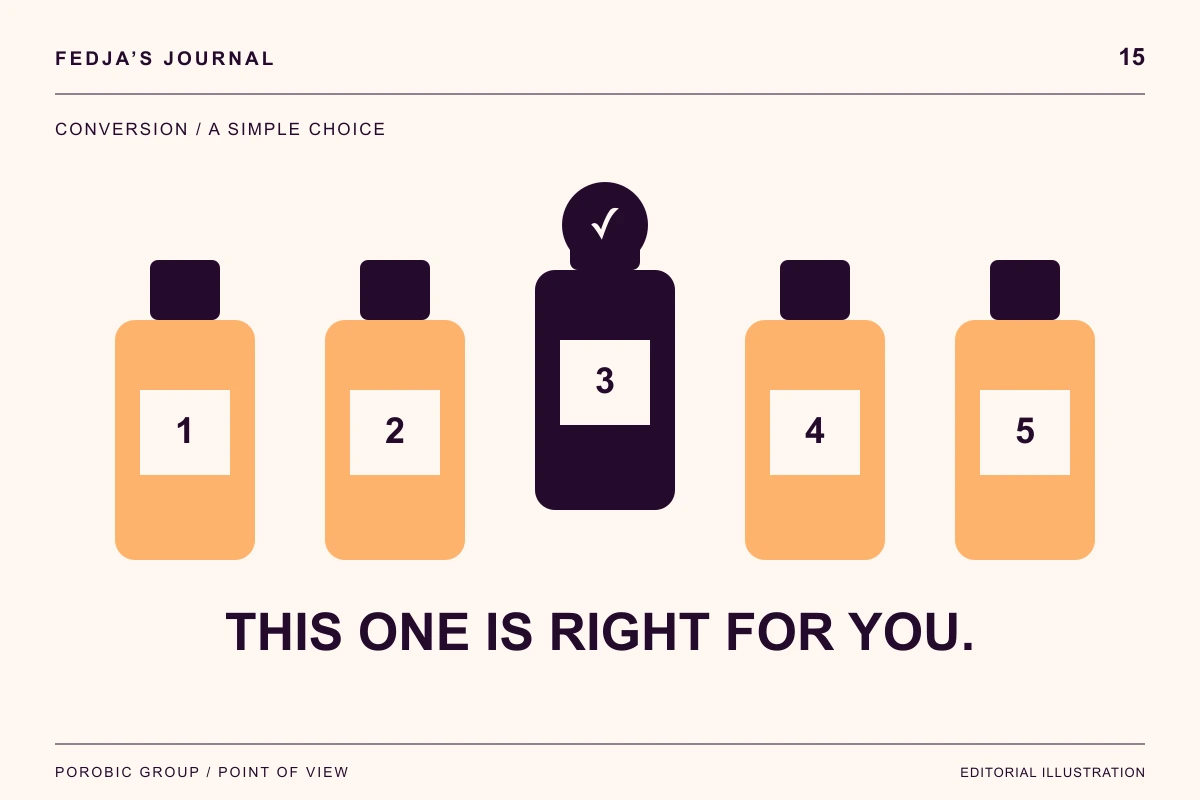
The customer should understand what suits her without first becoming an expert on our products. I use Homer and Lisa Simpson as an illustration. Lisa wants to read and compare. Homer wants to look and feel that this will do the job. A webshop needs room for both. That requires doing our homework behind the scenes and presenting product choice around what the customer is actually trying to accomplish.
The job is to get the deck clean before the weekend.
Imagine visiting a site to find something to clean your deck with. There are several kinds of cleaning soap, different sizes and product descriptions using words you rarely use. You suddenly need to understand the structure of the range to do your fairly simple errand.
You want to know which product suits the surface, how much you need and how to use it. The information needs to be accurate, but getting it should not require understanding the company’s entire range strategy. Start with what the customer wants to do. We can be the experts on the internal differences ourselves.
Explain the difference the customer needs to understand.
When two products look almost identical, the customer needs to understand why she would choose one. A difference in product name or ingredients list is not always enough. Explain what the difference means in use, with evidence that actually holds up.
Work through what the customer needs to know to choose correctly. Highlight the differences that affect use in images and copy. Keep the instructions and limitations that are necessary. Making the choice easier must not give the customer less chance of using the product correctly.
A guide should reduce the customer’s work.
A product guide can start with what the person wants to do, then ask the few questions needed for a relevant recommendation. Use language the customer understands and explain why a question matters. If we ask for a measurement, make it clear how to get it.
Show which product is recommended, why it fits and which relevant alternatives exist. A recommendation should make sense. If the guide suggests the same large bundle regardless of the answers, we have mainly built a salesperson with more clicks. There are more entertaining uses for our time and the customer’s.
Give the product image a job.
An image can help the customer understand what the product is for, its size and what comes with it. A sequence showing use can sometimes explain more than another styled still life. Choose the content around the question that needs answering.
A bundle can help when several parts are needed for the same job. Show the contents and what the customer may already have at home. Let her compare it with buying the parts separately. The word simple on a bundle image does little if she still has to work everything out herself.
Anyone who wants the detail should find it.
We can simplify the first choice and still provide proper product information. Put it in a sensible order: what the product helps with, who it suits, how to use it and then the detail. Customers arrive with different levels of knowledge and different needs to read further.
Details on contents, care, size and important properties should be easy to find. Do not make customers guess where to click for essential information. We can do Lisa’s thorough homework internally. The customer should then be able to look and think: aha, this one suits me. Done.
Ask someone to choose without your help.
Show the page to someone unfamiliar with the products and give her a clear task. Let her think aloud. Try to tolerate her misunderstanding what we consider obvious. If we need to give a spoken walkthrough so she chooses correctly, we have to go back and improve the explanation.
Then listen to the questions that keep coming and to those who ordered the wrong thing. They show us things a smooth purchase flow can hide. We have already learned the range. The customer came here to get the deck clean.

Fedja Porobic
Founder of Porobic Group. I write about advertising, ecommerce and the decisions that determine whether a business makes money.
Meet the Porobic Group team