The customer is waiting for a discount. Who taught her that?
The customer has learned to wait for the next code. It would be decent of us to ask who ran the training.
When a customer starts waiting for a discount, I think she is reacting quite reasonably. She is trying to understand when it pays to buy. We have given her a campaign calendar to practise on. Discounts can be useful, but I want us to look at the habit we are teaching and what the campaign leaves in the company. The person who just paid full price has a fairly interesting perspective too.
The customer seems to understand our campaign calendar
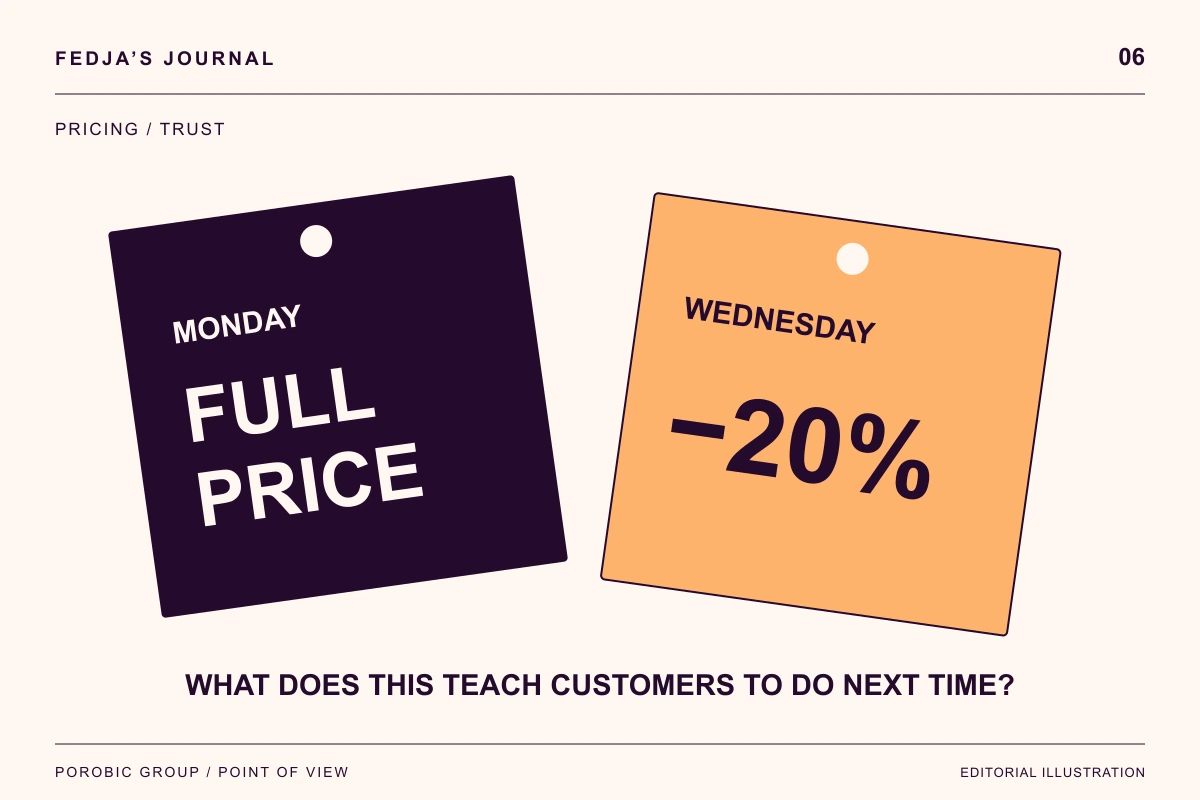
Imagine buying at full price on Monday. On Wednesday, the discount code arrives for the same product. It is a hypothetical example, but the logic is simple: if the pattern repeats, waiting can pay.
She may still want the product and like the brand. She has simply started adjusting the timing to the pattern we show. That is quite rational. When we then wonder why customers only arrive on campaign days, we should consider how clearly we have rewarded that behaviour.
An empty calendar slot is a weak reason for a campaign
A discount can release stock, get someone to try the product or give a loyal customer a good benefit. I want to assess it against that specific purpose. Otherwise it is easy to treat higher daily sales as the answer to a question we never asked.
Write down why the campaign exists before choosing the percentage. Which products and customers are relevant? What change do we hope to create? If the explanation is mainly that it has been a while since the last email, I would think again. Not every campaign has to start with the same code across the entire range.
The discount likes to take a large bite out of contribution
Here is a simplified, entirely hypothetical calculation, with all amounts excluding VAT. A product sells for SEK 1,000. Product cost is SEK 300, handling 100, payment 50 and advertising per order 200. After those particular costs, SEK 350 remains.
A twenty per cent discount reduces revenue to SEK 800. Holding those assumed costs constant leaves SEK 150. That is contribution before other costs, not the company’s profit. Your actual returns, fees and other conditions belong in the real calculation. The example shows why revenue alone is thin evidence for a decision.
Look at the days without confetti too
A campaign day is easy to love when the sales come in. I also want to look at the period around it. What happens to full-price sales? Do customers return between campaigns? What do we earn on the orders? Have we simply moved purchases from one week to another?
A before-and-after picture cannot on its own show whether we moved purchases between weeks. Demand is affected by more than the email. Compare relevant periods and document other changes. I want everyday sales in the same review as the campaign peak.
The full-price customer should not feel ripped off
I want the customer to feel happy about buying from us even when she paid the regular price. That starts with a price that makes sense in relation to the product and experience. If we can barely defend it ourselves, the next discount quickly becomes very convenient.
Also work through how customer service should handle questions from someone who bought just before a campaign. Agree the principles and communicate clearly. The aim is to help the customer understand the situation. She should not feel foolish for choosing us on the wrong day of the week.
A reasonable price has to survive an ordinary Wednesday
I favour pricing that feels reasonable outside the sale too. That requires thinking through how often we change the price picture and what our offers signal. A credible regular price is hard to build if we constantly tell the customer she ought to be paying less.
There are goods to sell and salaries to pay. I understand why a code can feel tempting when money is needed now. That is exactly why we should calculate what the campaign has to deliver and what it costs to need another one just like it next week.

Fedja Porobic
Founder of Porobic Group. I write about advertising, ecommerce and the decisions that determine whether a business makes money.
Meet the Porobic Group team