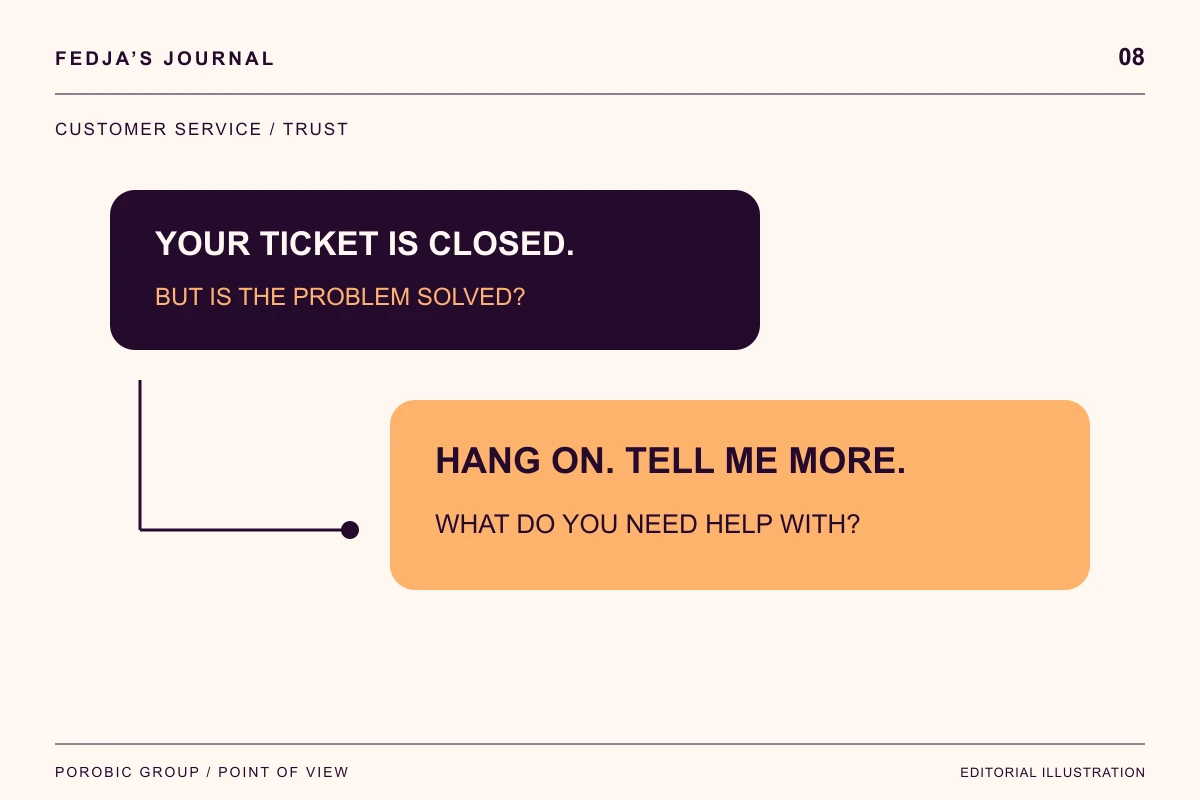
The customer said it on Monday. What has happened since?
We can be quick to increase the ad budget and slow to solve a problem the customer has already explained. I think the second speed deserves much more attention.

At Breakit’s E-com Day, I spoke about Data, Speed & Scale. Three words that easily bring to mind ad accounts, dashboards and how quickly we can increase sales. I started in the customer’s everyday life. Can I shower with the jewellery? What is in the product? Has anyone else tried it on their deck? Those questions contain information about what the customer needs to understand. For me, speed also means how quickly that information can become useful inside the company.
Customer questions are data too.
A recurring question before purchase can show what we have not yet explained. A misunderstanding after delivery can say something about the expectations we set. I want that information in the growth discussion. It does not need to start life as a tidy column to matter.
A single message is not the whole market’s voice, of course. Look at which questions repeat and which customers ask them. From there we can formulate a change worth trying without first pretending we have asked everyone.
The important distance is between teams.
Customer service can understand the problem while the person making the ads never hears about it. The person responsible for the product page may have another priority list. It then helps very little that each part works quickly and has a proper tool.
The customer experiences one company. The ad promises something, the site explains it and delivery has to keep the promise. I want to know how her question travels between the people responsible for those parts. Every team showing how fast it works tells us little if the question still gets stuck between them.
Give the question an owner who can do something about it.
There is a difference between forwarding information and taking care of a problem. Someone needs to decide whether the next step is a clearer image, a better answer on the product page or something that actually needs changing in the product. Otherwise the same question can circulate while the customer keeps wondering.
Who takes the next step, and when do we follow up? We should be able to answer without starting a project to redesign the process. If everyone thinks the question matters but nobody can act on it, it can easily sit untouched until the next meeting.
Creative, product and delivery need to talk.
If the customer asks how to use a product, perhaps the ad needs to show it more clearly. If the description leaves something unclear, the product page may need a better answer. If the product does not deliver what we promise, making the customer service reply sound nicer does little to help.
That is why I like working with the entire business. The question can start in a message and end somewhere very far from marketing. We need to follow it there. Otherwise we risk continuing to buy attention for the same ambiguity and calling it a new creative test.
Track how long it takes to reach a decision.
How long does it take from the customer describing a problem until someone decides about it? And how long from there until something changes? Those questions can make the waiting visible. Perhaps the right information is missing. Perhaps authority is missing. Perhaps several people know what needs doing but nobody has been given responsibility.
After the change, I want to see whether the misunderstanding remains. Read the new questions and try the explanation on someone unfamiliar with the product. Publishing a change quickly still says nothing about how helpful it became.
Take a customer question on a tour through the company.
Choose one of the questions that keeps coming. Follow it from customer service to the person who can change something. That gives Data, Speed & Scale fairly concrete meaning:
- Choose a recurring customer question and write down what the customer needs to understand.
- Follow who hears about the question and who can change something.
- See where it stops: is information, freedom to act or someone owning the next step missing?
- Decide on a concrete change and who takes responsibility for making it happen.
- Review what you learned before deciding the next action.

Fedja Porobic
Founder of Porobic Group. I write about advertising, ecommerce and the decisions that determine whether a business makes money.
Meet the Porobic Group team