Your budget assumes someone can clone themselves.
If the plan needs two of the same person, it is a wish with a salary line attached.
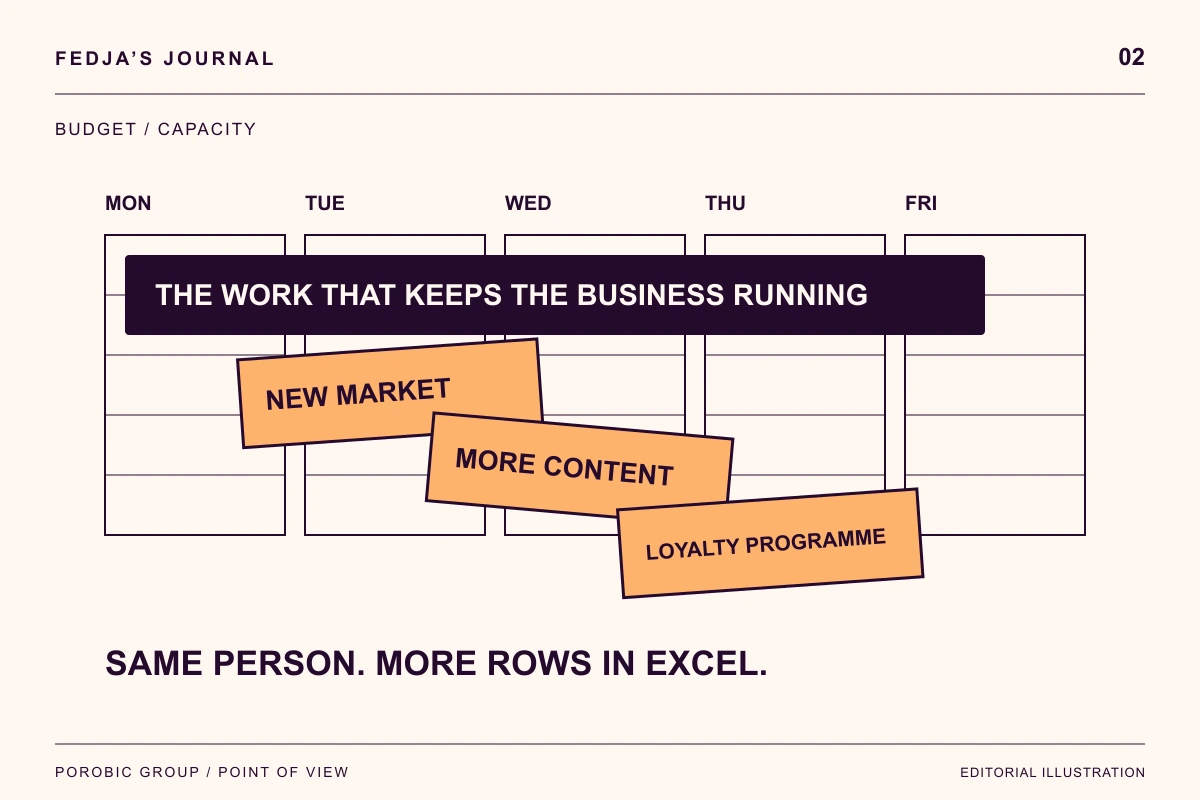
Budget 2027 can be full of sensible initiatives and still be impossible to deliver. A new market, a loyalty programme and more original content all land on the same person. The existing business is expected to keep running too, of course. That reasoning needs one more line: when is she supposed to find the time? Capacity has to be counted before the revenue from those initiatives moves into the budget.
Daily work has not taken a holiday because we made a budget
Next week’s campaign still needs a brief. Someone has to follow sales, answer the product question and make decisions when conditions change. That work hardly shrinks because the next big initiative has a better name in the budget.
I would start planning by writing down the recurring work with the people who do it. What has to work every week? What requires judgement and coordination? What happens only occasionally but takes up a lot of room when it does? The picture needs to make sense. It does not need to account for every minute.
Put the everyday work in first. Otherwise we pretend it is free and send the cost to the person whose plate is already full.
Make the capacity problem concrete
A worked example: a growth manager has twenty hours a month left after ongoing operations. We estimate that a market launch needs fifteen hours, a new loyalty programme ten and more original content production eight. We have booked thirty-three hours into a space of twenty.
That leaves thirteen hours missing. They will not appear because we add another row to the spreadsheet. We can move the start date, reduce the scope, share responsibility or bring in help. Writing her name down again is a fairly weak capacity strategy.
I also want the estimate to allow for uncertainty. A task we have never done is harder to estimate than something with an established routine. That should show in the plan.
Choosing what to drop is part of management’s job
When everything has the same priority, we push the decision down the organisation. The person doing the work has to guess which important initiative matters least this week. Then we can sit in the next review and talk about poor delivery. Convenient for us. Pretty poor leadership.
I want to be able to say what waits when something new arrives. Perhaps a market launches later, the loyalty programme starts with a simpler version or we begin with fewer content formats. Those are real decisions that make an assignment possible to understand.
One useful approach is to state the order out loud: if these two activities clash, we choose this one. Explain which questions the person can decide alone and when we need to discuss them together. Then we can stop calling a lack of clarity a lack of independence.
New ways of working rarely arrive fully assembled
It is easy to budget for the benefit of a new system or way of working. Implementation needs room too. Someone has to make decisions, clean up the inputs, try the workflow and help others understand how to use it. For a while, both the old and new may need to keep running.
Here I would ask what needs to be in place for the initiative to deliver what we hope. Naming a project owner on paper is rarely enough. If it needs material from the founder, decisions from finance or an outside specialist, their availability has to exist too.
If external help is supposed to free up time, the plan needs to say which work it takes over and when it starts. A line about the team getting support later creates no room in the calendar now.
The budget has to survive an ordinary Monday
A budget is full of assumptions. How quickly we can get things done is one of them. I therefore want to follow whether the work takes the time we expected, what blocks progress and what we have learned about the scope. That helps us adjust the plan while we still can.
When something takes longer, the first question should be what changed. Perhaps the task grew. Perhaps an important customer issue came up. Perhaps we gave someone responsibility without authority. Different causes need different decisions, and more reminders solve surprisingly few of them.
I like ambitious targets. But if the calculation requires the same people to squeeze in even more, we have budgeted for overtime and called it growth. I want that discussion before the year starts.

Fedja Porobic
Founder of Porobic Group. I write about advertising, ecommerce and the decisions that determine whether a business makes money.
Meet the Porobic Group team